

Proving your English: Quick tests or trusted qualifications?
In today’s global world, an English certificate can open doors — for study, work, or even visa purposes. Recently, quick and fully online tests such as the Duolingo English Test (DET) have gained popularity thanks to their flexibility and speed.
Many learners ask: “Can you really learn a language with Duolingo?”, “Can Duolingo make you fluent?”, or simply “How good is Duolingo?” How does this new arrival compare with Cambridge English Exams, part of the Cambridge English Qualifications suite?
This guide helps Swiss schools, teachers, and candidates understand how Cambridge English Exams differ from the Duolingo English Test (DET) — and which option aligns best with Swiss educational expectations.
DET or Cambridge? A clear comparison for Switzerland
How does Duolingo work? Main features
- Adaptive difficulty: The test automatically adjusts its question difficulty depending on the candidate´s answers. While this makes it efficient, it also means that no two test experiences are identical, which can make preparation less predictable.
- Fully online and fast: The Duolingo English Test can be taken from home without booking a fixed date, and results are usually available within two days.
- Recognition: The test has seen growing acceptance among some international universities, mainly in North America. In Switzerland and much of Europe, however, DET acceptance remains limited and varies significantly from institution to institution.
- Format and origins: Developed by Duolingo in 2014 and officially launched in 2016, the DET gained attention during the COVID-19 pandemic. Despite its popularity surge, large-scale independent research into its long-term reliability and predictive validity remains developing.

Cambridge English Exams: Main features
- Over 110 years of expertise: The first Cambridge English exam was held in 1913. Since then, these exams have been refined through continuous research and collaboration with linguists and educators worldwide.
- Global and Swiss recognition: Trusted by over 25,000 universities, employers, and government bodies — including Swiss universities, Fachhochschulen, teacher-training institutes, and apprenticeship programmes. Many Swiss schools integrate Cambridge English directly into their curriculum, and Swiss employers regularly request Cambridge certificates in recruitment.
- CEFR alignment (A1–C2): Each exam corresponds to an exact language level, allowing measurable progress.
- Real-life communication: Assess all four skills (Reading, Writing, Listening, Speaking) through authentic tasks — including live, face-to-face speaking components.
- Research-based design: Every task is grounded in linguistic research and pedagogical practice to reflect real-world English use.
Cambridge exam vs Duolingo English Test: Key differences at a glance
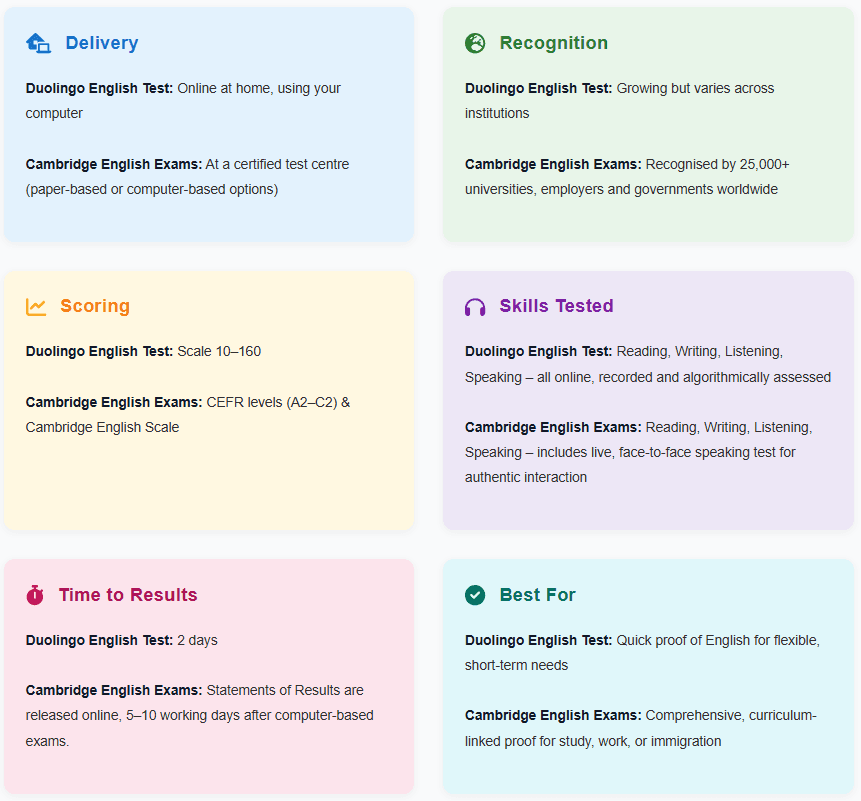
Which exam fits what goal?
Duolingo English Test
DET offers speed, flexibility, and a low price, making it appealing for quick applications. Ideal for candidates who need a quick, accessible certificate for international applications, especially where institutions explicitly accept DET results.
However, many ask: Does Cambridge University accept Duolingo? The short answer is no. Cambridge University — and the majority of European universities — do not accept DET. This is an important consideration for Swiss students applying abroad.
This means that accepting the Duolingo English Test is not yet a universal trend, and not all universities recognise it. Make sure to check the language-proficiency requirements on each institution’s website to confirm what they accept.
Cambridge English Exams
Recommended for schools, long-term learners, and anyone planning to study, train or work in Switzerland or Europe.
They match Swiss educational standards, offer predictable preparation pathways, and are recognised widely by Swiss employers and institutions.
Fast prep vs. deep learning: What actually helps students succeed
Cambridge English Exams
Preparation for Cambridge English exams builds not only language proficiency but also strategic linguistic intelligence. Although the preparation process takes longer, candidates gain skills that extend well beyond the exam. They learn to analyse audiences, anticipate counterarguments, structure coherent messages, and adjust their language in real time, mirroring the demands of university study and professional communication.
A Language Testing (SAGE Journals, 2023) study found that students admitted based on DET scores performed significantly less well academically than those admitted with IELTS or TOEFL. This suggests that fast, format-based testing may not develop the deeper communicative skills required in demanding academic contexts.
Duolingo English Test
Preparation typically focuses on test mechanics rather than broader competence. While efficient, this does not foster long-lasting communication skills.
A recent ELT Journal study confirmed that research-based exams like Cambridge English correlate with better academic outcomes, while students admitted through newer online tests often struggle more with academic and communicative tasks.
This supports what educators could observe these days: comprehensive testing with live interaction — such as Cambridge English — better predicts real-academic-world success.
Conclusion: Choose reliability that lasts
Quick, online tests may offer speed — but reliable progress and recognition are built over time.
For anyone seeking qualifications that endure, shape real communicative skills, and open doors across Switzerland and beyond, Cambridge remains the smarter, more strategic choice.
Have questions?
Want support choosing the right exam or preparing your students?
Swiss Exams is the leading provider of Cambridge English Exams in Switzerland. We support schools, teachers, and candidates with expert guidance, preparation resources, and secure exam administration across the country.