

Artificial Intelligence is changing the way we learn, work, communicate, and solve problems. Many people assume that because AI can translate languages, write emails, and generate text, language skills will become less important in the future.
The reality is quite the opposite.
As AI becomes more powerful, the value of strong language skills and critical thinking increases. The people who benefit most from AI are not necessarily those with the most advanced technology. They are those who can communicate clearly, think critically, evaluate information, and make sound judgments.
This is one of the reasons why Cambridge English Qualifications remain highly relevant in the age of AI.
More Than Just Learning English
At first glance, Cambridge English Qualifications appear to be language examinations. They assess reading, writing, listening, and speaking skills across internationally recognised proficiency levels.
However, anyone who has prepared seriously for B2 First, C1 Advanced, or C2 Proficiency knows that success requires much more than vocabulary and grammar.
Candidates must learn how to:
- Analyse information
- Compare different perspectives
- Evaluate arguments
- Identify assumptions and bias
- Present evidence-based opinions
- Construct logical arguments
- Communicate complex ideas clearly
- Make reasoned decisions
These are not only language skills. They are cognitive skills that are becoming increasingly important in an AI-driven world.
The Hidden Connection Between Cambridge Exams and AI
Many of the skills required to succeed in a Cambridge English examination are remarkably similar to those required when working effectively with AI.
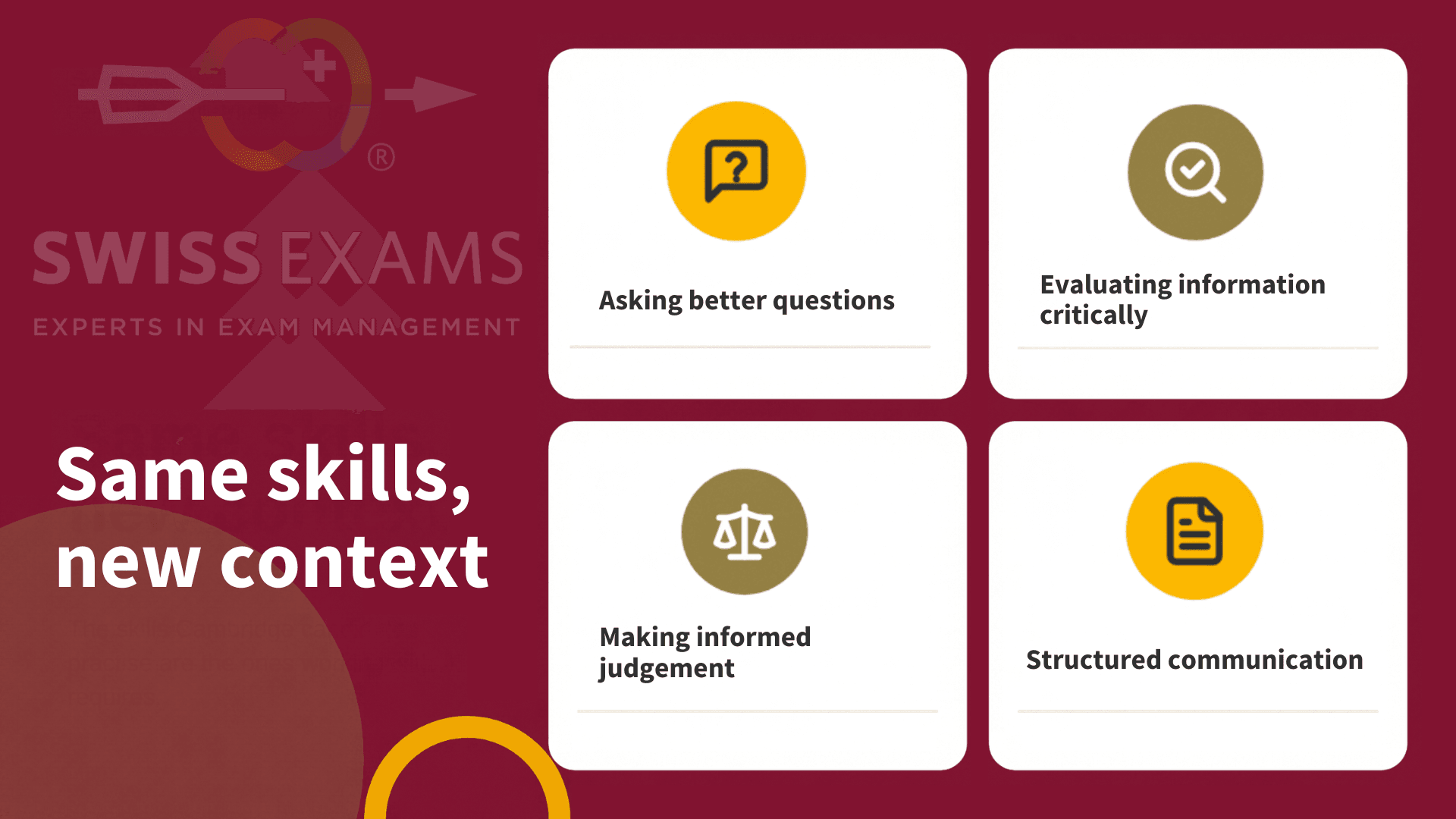
1. Asking Better Questions
A powerful AI system can only produce high-quality outputs when given clear instructions.
This process, often referred to as "prompting," requires users to:
- Define objectives clearly
- Structure requests logically
- Provide sufficient context
- Use precise language
Candidates preparing for Cambridge exams develop exactly these abilities. Through speaking and writing tasks, they learn how to formulate ideas accurately and express their intentions clearly.
In other words, strong English communication skills lead to stronger AI prompting skills.
2. Evaluating Information Critically
AI can provide impressive answers. However, AI systems can also produce inaccurate, incomplete, or misleading information.
Users therefore need to evaluate outputs critically.
Cambridge candidates practise this constantly.
When reading texts, they must:
- Distinguish fact from opinion
- Identify the writer's purpose
- Recognise assumptions
- Understand implied meaning
- Evaluate the strength of arguments
These same critical thinking skills help users determine whether an AI-generated answer is reliable.
3. Making Informed Judgments
AI can generate multiple possible solutions to a problem. The responsibility for choosing the best solution remains with the human.
Cambridge examinations encourage candidates to:
- Consider different viewpoints
- Compare alternatives
- Assess advantages and disadvantages
- Reach justified conclusions
These are exactly the skills required to manage and supervise AI effectively.
The future belongs not to people who blindly trust AI, but to those who can critically assess its recommendations.
4. Structured Communication
One of the most valuable skills in the modern workplace is the ability to communicate complex ideas clearly.
Cambridge candidates learn to:
- Organise information logically
- Build coherent arguments
- Adapt communication to different audiences
- Support opinions with evidence
These competencies are increasingly important when collaborating with AI systems, colleagues, clients, and international teams.
AI may help generate content, but humans must still decide what should be communicated and why.
English as the Operating Language of the AI Economy
Although AI tools increasingly support multiple languages, English remains the dominant language of international business, technology, research, and digital innovation.
Most AI research, technical documentation, and global business discussions are still produced primarily in English, and many professional communities operate in English as well.
Individuals with advanced English skills gain direct access to:
- Global knowledge
- International collaboration
- Professional networks
- Research and innovation
- Emerging technologies
Cambridge qualifications help learners develop the level of language competence needed to participate confidently in these global conversations.
Human Skills Become More Valuable
Paradoxically, the rise of AI is increasing the value of uniquely human capabilities.
Employers increasingly seek individuals who can:
- Think critically
- Solve problems
- Communicate effectively
- Evaluate information
- Work collaboratively
- Exercise sound judgment
These are precisely the skills that are strengthened through successful preparation for higher-level Cambridge English examinations.
A Cambridge qualification therefore demonstrates more than language proficiency. It signals that a candidate can process information, communicate clearly, and engage in analytical thinking.
Preparing for the Future
The future workplace will not be a competition between humans and AI.
It will be a collaboration.
The most successful people will be those who can combine human judgment with artificial intelligence. They will know how to ask the right questions, evaluate the answers, make informed decisions, and communicate effectively.
Cambridge English Qualifications help learners develop exactly these capabilities.
By mastering English, candidates are not only gaining access to international education and career opportunities. They are also developing many of the critical thinking, communication, and reasoning skills that will define success in the AI age.
In this sense, preparing for a Cambridge qualification is no longer just about learning a language.
It is about learning how to think, communicate, and thrive in a world where humans and AI work together.